Is Voiceover Still Worth Getting Into ?
I’m writing this at the end of 2025, when I’ve personally seen an up-surge in VoiceOver business over the past 6 months. Things feel more optimistic than they did last year and it’s worth taking stock and asking the question:
‘Is Voiceover Still A Good Business To Get Into’ ?
Voiceover, A Historical Perspective
One of my favourite articles of all time is Jeffrey Bernard’s 1978 feature on Tom Baker for the Sunday Times. Called ‘A Life In The Day’ it’s an hilarious jaunt through the backstreets of Soho between soap commercials & frequent visits to the Coach & Horses. Its a snap-shot of a Bohemian lifestyle that only Tom Baker can do justice to.

There’s a fair bit of artistic license in there, but it conjures images of a jobbing actor, living on the edge but very much alive.
In those days, Voiceover work was the realm of actors between proper jobs. It was taken lightly, served to pay the bills and was exclusively available to those within a short bound of inner city recording studios (mostly London).
In the 80s and 90s we see greater expansion of recording networks, the emergence of more creative centres in other cities and the realisation that Voice Work can be a stand alone career in its own rite.
The market remained relatively small and was dominated by a handful of dedicated professionals, many of whom were not actors but started out in broadcast and found their way in through industry connections.

The Influence Of Technology On Voiceover
The evolution of Voiceover as a viable career started to grow exponentially with the arrival of Digital Audio Work-stations in the 2000s. This made recording both accessible and affordable, outside of established studios, but it still had a way to go.
From 2010 onwards the tech steadily improved, we saw the arrival of remote recording capabilities at affordable rates and the stage was set for Voice Actors to set up their own studios, often from home.
If there were technology knowledge gaps, Youtube was a useful resource. Around 2018 a market opened up for training, resources and a whole industrial complex around the Voiceover World.
The Effect of COVID 19 on Voiceover
The impact of Covid 19 on the Voiceover Industry cannot be under-stated. Its legacy was profound for all kinds of employment and we saw a massive shift in the work-force as people sought opportunities to continue working from home post pandemic.
Work, Life Balance was the new buzz phrase and people quickly latched onto the idea that Voiceover was an easy way to make money from the comfort of your home. After all it’s just talking right ?
The Effect of AI on The Voiceover Industry
You have to look at the arrival of AI technology and how it influenced the VoiceOver Industry, in the context of all that went before.
From 2022 there was a burgeoning workforce of hungry new talent.
We start to hear noise about AI and how it might affect Voiceover. At the same time we see other creative industries like film production under immense financial strain as the world re-calibrates and adjusts to a de-centralised, portable, do-it-yourself approach to creative projects.
Everything is within reach, the knowledge, the equipment, the price.
AI hit the industry like a bomb; a perfect storm if you like. Or so the story goes !

Voiceover Is Still Here
Given all the worry, portents of doom and predictions around the demise of Voiceover due to AI, it’s still here and it’s doing pretty well as a creative service.
The noise around AI has been quite effective I think and I’ve personally not seen the industry crumble in the way that many predicted it would.
Are You For or Against AI In Voiceover ?
On social media channels like Linkedin, I see comments from two sides of the AI coin:
1. The engineers who tell creatives that AI is here and it’s not going away, so you might as well get used to it.
2. Voice Artists talking with disdain about engineers who lecture endlessly on what constitutes art.
The narrative is binary and discussions get heated because it fuels fears of professional voice artists not being able to put food onto the table. This isn’t helped by the tone of the engineers, who couldn’t give a damn about the creative industries.

Where Is Voiceover Now ?
I feel we’re at a critical point in the industry’s journey, but quite optimistic and we might even be getting beyond the hump.
AI is still there and will remain a factor in how the market operates but my overwhelming experience of what clients are asking for today, is ‘no AI Voice’.
In fact I see this as a firm stipulation in contracts every single day.
There is a chunk of work out there that has been taken over by AI for sure. Interactive Voice Recording (IVR) jobs, or telephone answering recordings were the lowest hanging fruit.
They disappeared for a while, but guess what, they’re coming back.
I see people using AI to generate books, then generating audiobooks from that text. It’s terrible stuff though.
There’s lots of AI generated content that makes a claim to sit on the artistic shelf of course, from video to music, e-learning to explainers.
It’s opportunity economics though, something beyond what went before.
I get a sense that creative industries took a punch in the face, looked at the protagonist, said ‘cheers for that’ and then got back on with what they do best, ‘being creative’.
A demand For Authenticity
I said a year ago that I hoped there would be a bounce in favour of creativity in a couple of years, once the novelty of AI had run its course.
I think it’s happening now.
Clients are not stupid, they understand that authenticity is crucial. They are more discerning than the doom-mongers give them credit for.
Why would you invest so much time, money, blood and sweat into creating your master-piece, just to throw an AI voice on it at the end ?
Yes, it’s a way of saving money for folk with small budgets, but I’m talking macro industry stuff here.
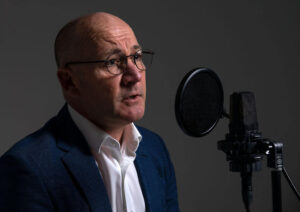
What is AI Voice Good For ?
I think it has a place in video production, where a temp track is needed.
A Talented Voiceover Community
The politics of fear have done a job on a lot of new VO talent. Since the late 2010’s it’s an industry that’s had a low entry bar, but has and always will be one that takes a long time to get traction in.
The market got saturated post pandemic at a time when work dried up for a while. It now appears to be re-adjusting naturally as reality bites for those looking for a get rich quick scheme.
Lessons From The AI Voiceover Threat
The Voiceover Community prides itself on being hugely supportive and friendly. That’s always been my experience too.
If the industry has survived an existential threat, I’d say we were lucky. Yes, we made a lot of noise and I personally believe that it was both heard and responded to.
However, it’s another example of how creative industries are easy targets for charlatan opportunists. We lack teeth and spend all of our time talking about how we are a:
‘People Business’
Well that’s just lovely, but if we want to have a business that’s viable in 5 years then it’s time to kick the lambs that are dancing around our feet firmly and squarely in the nuts !
Not all has been sweetness and light though. I’ve witnessed how newbie talent has been subtly thrown under the AI bus in various commentaries and blogs.
When times were hardest, it was often cited that AI will only affect the bottom end of the market, so ‘I’m alright’ Jack. The truth is that we, as an industry need to support emerging talent for the good of the industry overall.
There just has to be a consistent set of standards applied across the board, or we’ll be right back here again.
Voice Artists Need to:
- Not under-cut the market
- Charge market rates and educate those that offer insulting ones
- Approach the running of a VO business professionally, with the ability to switch hats as freelance business owners.
- Be alive to scams and share details when we see them.
- Support emerging talent to keep the industry alive.
- Relax.

Conclusion: Is Voiceover Still Worth Getting Into ?
If you’re in for the long haul, willing to learn, constantly looking to improve your acting skills, are good with clients, prompt, professional and have the capacity to wear every hat lightly (from marketing, to finance, to HR), then you’ve got as good a chance as anyone.
It’s always been a tough industry, so don’t be deluded by the idea that success can come quickly. It’s not working down a coal mine, but it is hard work.
If you don’t have the appetite to spend a few years eating dirt, followed by a few years of feast and famine cycles, before hopefully, eventually being able to break even and strive towards making a consistent profit then the answer is no.
There is still a degree of market saturation, but that should be viewed against vastly expanding markets. Hollywood is under strain, but that’s because end user behaviour has changed and it’s not indicative of media demand for VO.
Demand for digital media remains insatiable, supported by talented voice artists who produce authentic, broadcast quality audio. That can only be a huge positive for Voice Artists around the World.

About The Author – James Fowler Voiceover
James Fowler is a seasoned British Voice Artist with a passion for game characters, audiobooks and audioguide narrations. Over the past 7 years he’s worked with leading brands to communicate their message with clarity and a trademark British RP warmth.
He’s featured in AAA games like RAID, Shadow Legends and the imminent ‘Nioh 3′, due out in Feb 26. He is the voice of the UK Houses of Parliament and Hampton Court Palace Audioguides, along with many museum and city guides across Europe.
He’s narrated over 50 audiobooks for clients around the World, spanning historical fiction and non-fiction, futuristic Sci-fi, childrens’ content and educational material.
James has shouted instructions on the sinking Titanic, sold everything from Romanian Apple Pie to Luxury Apartments in Nyanga and is about to embark on the complete works of Shakespeare. That said, he does come up for air occasionally so contact him between Sonnets and he’ll be happy to discuss your project.